Second Street & Clubbing Dance Meeting
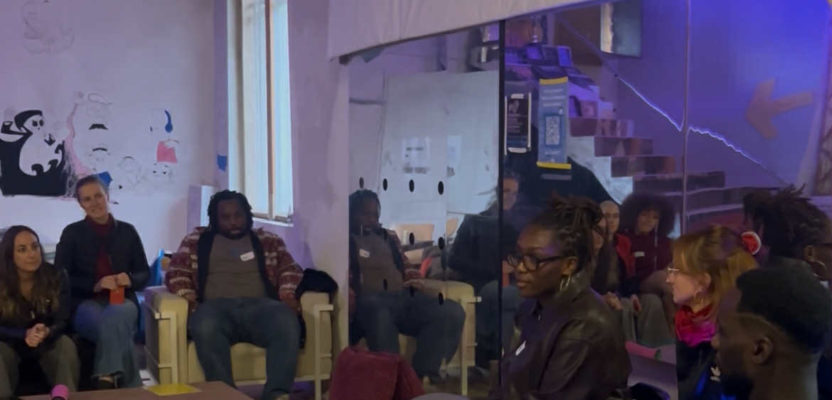
On 13 October 2025, nearly thirty artists — dancers, educators, organisers and cultural workers — gathered at Dakh for the second meeting dedicated to street and clubbing dance practices, co-organised by Get Down Agency, the Réseau des Arts Chorégraphiques (RAC) and Kassy Bondoko.This meeting was part of a broader process aimed at gaining a deeper understanding of the realities of the sector, fostering a collective voice, and co-building concrete courses of action for the future.
A Definition in Motion: What Are Street Dances Today?
The discussions quickly highlighted that street dances cannot be reduced to a single style, but rather form a constellation of vernacular practices, born out of diverse social and cultural contexts: hip-hop, house, clubbing, krump, Afro styles, and many others.While some participants associate them with “the street” as a space of freedom, encounter and improvisation, others noted that the term street has become a catch-all label — too broad or overly institutionalised.The notion of “vernacular dance” then emerged as a more precise alternative, allowing these practices to be grounded in their histories, geographies and communities of origin, while remaining relevant within institutional contexts and artistic funding frameworks.
Several shared values were also highlighted:• authenticity and spontaneity;• accessibility, outside of traditional academic frameworks;• a strong sense of community belonging;• a dimension of expression and cultural resistance;• a history often rooted in marginalized communities.
This diversity is the strength of street dances, but it also highlights the importance of a shared vocabulary — one that can unite without homogenising.Imagining a common space: a place to gather, create and grow.The second axis of discussion focused on the idea of a dedicated space, conceived by and for the community. Throughout the exchanges, a clear consensus emerged: dancers need a living, safe and collaborative space, capable of hosting training sessions, jams, meetings, workshops, resources and collective initiatives.
While Dakh currently plays a central role, it still faces material, structural, and logistical limitations.Participants therefore envision a broader network, including:• regular sessions across multiple cities;• collaborations with schools, cultural organisations, or independent spaces;• increased exchange between groups, styles, and territories;• the creation of a resource centre to share knowledge, archives, references, and tools.
The question of movement between cities (Brussels, Liège, Antwerp…) was also discussed: the community recognises the need for a collective effort to break out of established routines, while highlighting challenges related to communication, mobility, and visibility.
What Role for RAC and Get Down?
The meeting provided an opportunity to clearly express the community’s expectations of RAC and Get Down:• identify the needs of artists and organisations;• facilitate access to information (grants, networks, frameworks, legal statuses);• support project structuring: drafting, positioning, communication;• contribute to the institutional recognition of street dances;• build bridges between cities, disciplines, networks, and institutions;• support the emergence of a shared, sustainable, and representative space.Discussions also highlighted a strong need for administrative and institutional clarity, particularly regarding legal statuses, funding, eligibility criteria, and financial perspectives.Several participants emphasised the importance of thinking big, defending the artistic value of these practices, and recognising that street dances deserve support comparable to recognised artistic disciplines.
And now ?
This second meeting confirms the richness, diversity, and depth of street and clubbing dance practices in Belgium.It also demonstrates a shared commitment: to strengthen collectively, structure what already exists, and create functional tools for current and future generations.Next steps include:• continuing reflections on terminology and definitions;• developing inter-city and interdisciplinary collaborations;• drafting a reference document based on the exchanges;• organising further meetings to continue this co-construction process.Street dances, in all their diversity and vitality, have an essential role to play in the Belgian cultural landscape. This initiative aims to give them the space, visibility, and resources they deserve.