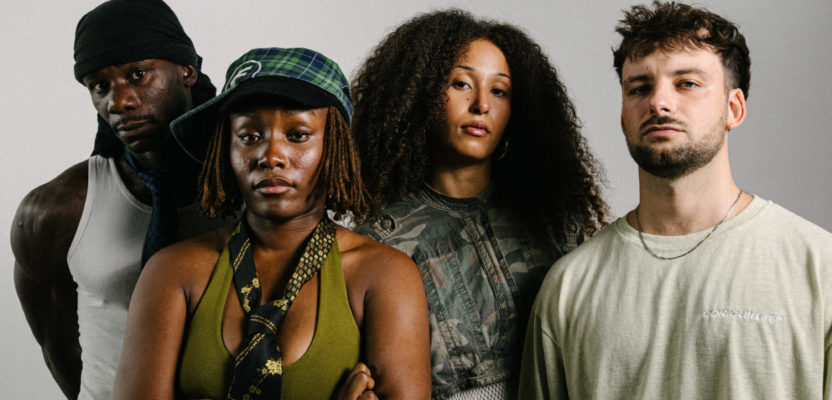
NEXUS – EN QUÊTE D’UNE VOIE BY OUMAR DIALLO / KIFESH COMPANY
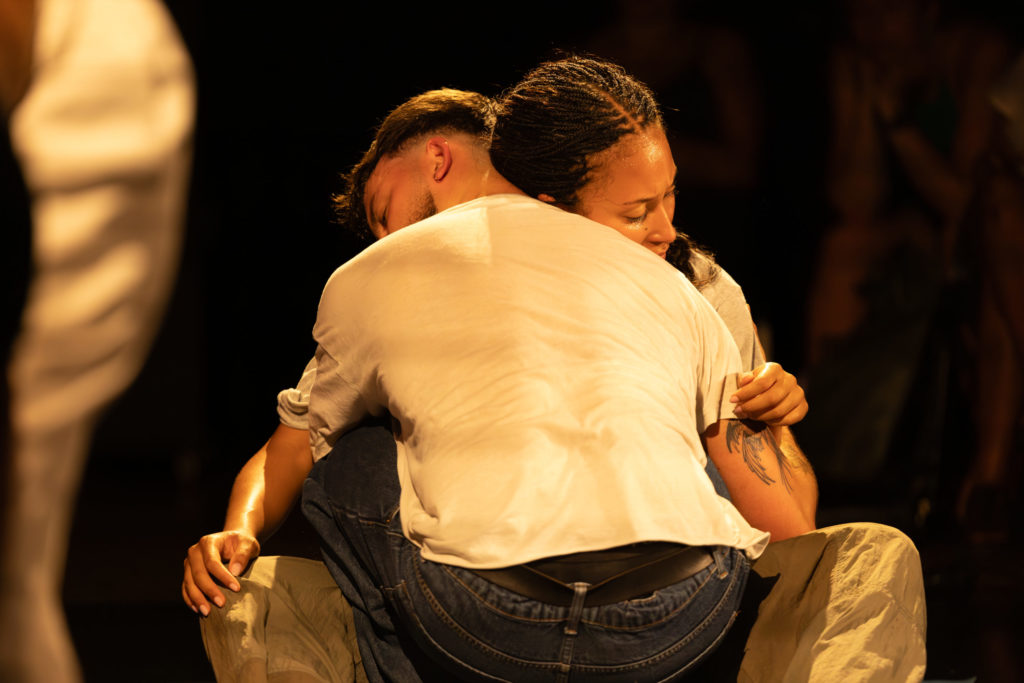
Born out of many months of research that began in 2025, this choreographic work transforms a personal experience into an introspective and emotional journey. Far from being intended exclusively for those who have experienced mental health issues, this piece, filled with profound vulnerability, aims to resonate with as many people as possible. It encourages empathy, an understanding of others and of oneself, and to find their own path through life. Through this project, Oumar offers a journey of resilience and healing, driven by a multifaceted artistic language that draws its energy from street and club dance styles, notably breakdancing, house and hip hop.
Following his acclaimed duet with Kifesh 2.0, Oumar Diallo will premiere his new piece, Nexus – En quête d’une voie, at Les Brigittines (Brussels) from 11 to 14 November 2026 as part of the Brigitte en Novembre festival.
An artist rooted in the city :
Oumar Diallo, alias Owdi, is a hip hop artist from Brussels specialising in popping and freestyle hip hop. He is a versatile artist : dancer, choreographer, director of the Kifesh company, performer, DJ and organiser of events such as CreativBoil and Supreme Cypher.
Oumar describes himself as an artists of the city. He grew up in Brussels within the hip hop community and today plays an active role in that community and, more broadly, in Brussels’ street dance and club scenes, whether through his various roles or simply through his presence and his love of dance and music.
THE QUESTIONS AT THE HEART OF NEXUS – EN QUÊTE D’UNE VOIE
The initial impulse
The creative spark behind this project lies in the relationship between freedom and altered reality, the central theme of the play. This connection stems directly from his personal history.
“ During certain psychotic episodes I’ve experienced, I felt a kind of freedom – but an extreme one. A sense of fulfilment and freedom that you don’t find, shall we say, in the real world. And the paradox, precisely, is that in a world where we seek this freedom so much, where we fight for it, how on earth could I have felt so free and so fulfilled when I was actually in such a bad way? ”.
This gives rise to a paradox: the intensity of this exhilarating feeling, yet the refusal to return to it because it remains synonymous with distress. It was from this realisation that the creative exploration began, and it then developed around the desire to demystify mental and psychiatric disorders, which are often characterised by a disconnection from reality.
What is reality?
“I think everyone has their own reality to some extent, their own relationship with reality, and each of us tries to forge a relationship with it that suits us.”
Oumar’s research thus raises philosophical and political questions: what is reality? What is considered true, as rooted in reality? Who has the power to assert that one thing or another is real, and who is dismissed as mad? For people experiencing disorders, their lived experiences and sensations are very real indeed.
“For me, the memories of these episodes are ultra-real. In my intuition, that is what I experienced. Although it is a particular perception, for the person experiencing it, it is very real.”
Through the concepts of ‘delayed frequency’ and ‘delayed reality’, Oumar does not view these states as entirely detached from reality or disconnected from it. He thus seeks to deconstruct the historical and collective projections surrounding the idea of the ‘madman’ when discussing psychiatric disorders.
An experience that is still difficult for society to understand
For Oumar, our Western context distances us from the spiritual. It pushes us to distance ourselves from anything that is not socially and politically considered ‘rational’ and ‘real’. He thus questions a worldview which, in his view, leaves little place for that which is beyond our grasp – the spiritual, the intangible, the irrational – things that are kind of incompatible with capitalism, consumerism and the drive for productivity as we know them. However, other, more spiritual and religious perspectives may perceive these disorders through the lens of possession by spirits.
Among these different ways of naming and understanding them, Oumar’s idea is to propose an alternative approach to scientific or religious ones – one that aims to open up a dialogue about the loneliness, shame and lack of understanding that people experiencing psychiatric disorders may face. For despite the solutions offered to them, people remain alone in their distress. Furthermore, the collective unconscious is full of projections, stereotypes and fears surrounding psychiatry. Yet psychiatric disorders cover a broad spectrum, ranging from forms that are sometimes ‘invisible’ to more severe ones.
According to Oumar, the topic of mental health often stops at what is more easily understood or accepted, such as depression or burnout. So, although people are becoming more open to talking about mental health, Oumar’s aim is to broaden the discussion to include knowledge and understanding of psychiatric disorders. This starts with being able to talk about them.
“Removing the shame and opening up the debate. Bringing psychiatry closer to us as a society so that we can simply talk about it, with spaces where people can speak freely. As soon as I mentioned it, I realized that everyone is affected in one way or another, directly or through people we know. The aim of the play is to open that door. ”
Oumar asks this question: ‘So what do we do about it as a society?’. This implies that the answers must also be collective. It is important to create spaces where those concerned can speak out, without shame and without their experiences becoming a secret.
“It’s extraordinary, but not abnormal.”
In search of a path
One fundamental question has guided Oumar’s work: how to (re)build oneself and continue to live with the memories of an altered reality? For Oumar, it is a question of life and resilience.
“No matter what you go through, no matter what solution is offered to you, afterwards you have to carry on living. That raises a broader question about life itself. For me, all of this is part of a life experience. What I hope to achieve with this play is to bring these issues closer to us, so that we realise this is an experience just as legitimate as any other.”
The play invites us to reflect on how to keep moving forward in life, and it is not intended just for people with mental disorders. Nexus – En quête d’une voie is an invitation to reflect on our own lives. The play is designed to be received by everyone.
“It’s one path, it’s not the path.”
With this sentence, Oumar addresses the question of reconstruction: there is no ready-made answer, it is not universal. The answers emerge through this personal journey, through self-reflection and discussions with trusted individuals, whether in a therapeutic setting or on a more personal level. His play therefore does not claim to answer the question of ‘how’, but rather poses it and invites everyone to find their own path.
Transmission with the audience:
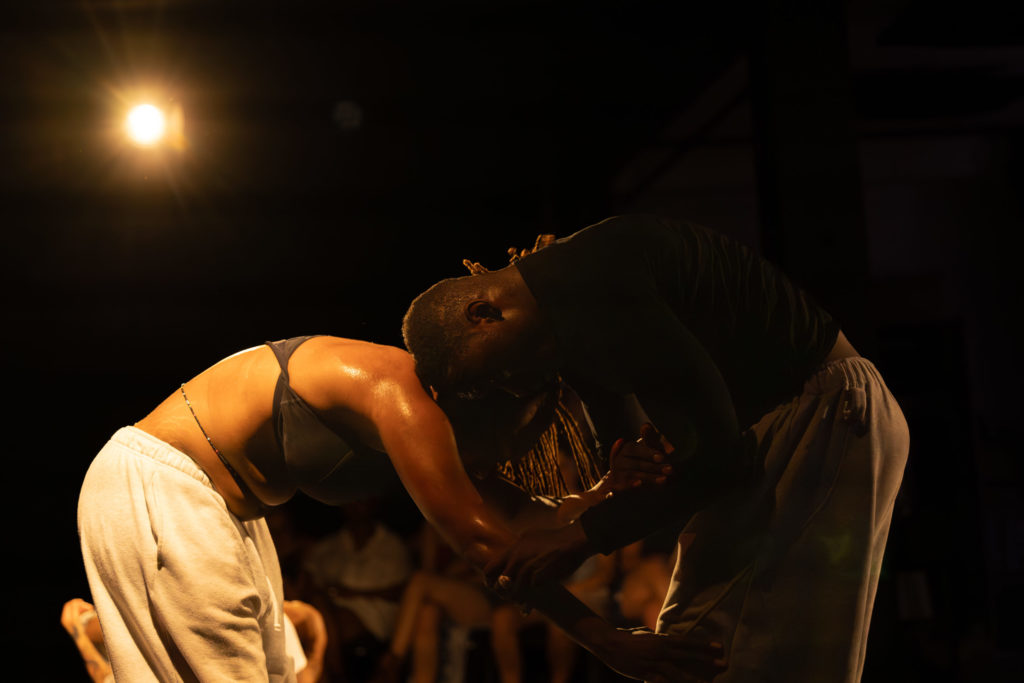
If the play invites everyone to engage in personal introspection, Oumar also hopes to encourage understanding of others. One of Oumar’s creative driving forces has been to build an emotional bridge with the audience.
“To be able to create empathy in the audience so that they can understand. If you can put yourself in someone else’s shoes, you can understand them better and relate to them better.”
Oumar explains that, faced with the clichés and the complexity of this experience, it is human to be afraid of psychiatry. But the play aims to confront the audience with this fear in an attempt to overcome it through understanding:
“It’s a sensitive and vulnerable play, the performers lay their hearts and souls open to the audience, people can relate to it.”
Beyond the illness itself, Oumar’s main aim is to convey a message of hope :
“It doesn’t stop at the illness, it’s also about rebuilding oneself and being able to stand in this world.”
Creating to be understood:
As explained earlier, the piece is aimed at everyone, although Oumar hopes to reach people directly affected by these disorders, or who have been confronted with them through their loved ones.
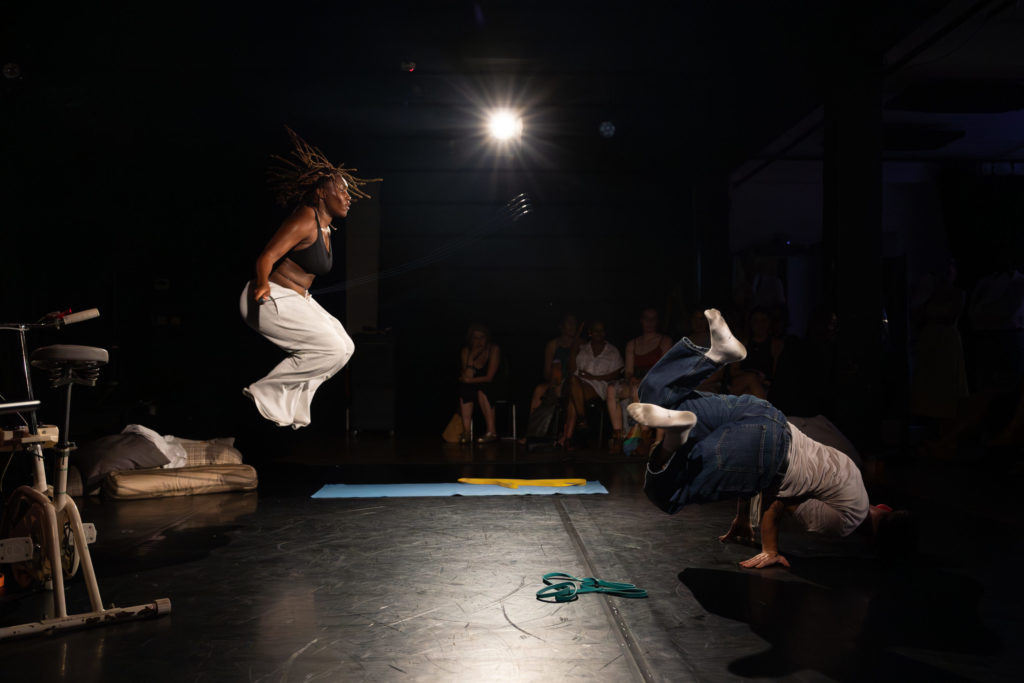
Oumar tries to create a piece that is readable, as dance can sometimes be abstract to an audience that is not necessarily familiar with the codes of choreographic language. For example, sport, an important element of the piece, embodies a language of movement that everyone can understand. Oumar uses this as a bridge to bring the audience to an understanding of his creation.
That said, for Oumar, this approach has nothing to do with treating the audience like children or oversimplifying his personal reflections or his creative process. His creative process involves deploying his own artistic language to construct a piece that reflects who he is, that speaks to people, whilst remaining artistically demanding.
If the word ‘accessible’ is today associated with a certain form of condescension linked to cultural elitism, Oumar seeks to communicate with his audience through dance, but also through sport, text, music and set design.
“For me, providing keys of understanding is important. That’s how I create because I’m like that. When I create, I don’t think people are too stupid. I just think of my younger self, who didn’t necessarily have a huge cultural capital*.”
CREATING THE PIECE
The work of interpretation
“It’s no longer my project, it’s our project.”
For this production, Oumar has brought together four dancers from the Belgian street and club scenes: Jonathan Tshimanga (alias Dikaay), Kassy Bondoko, Aminata Soumaré and Lucas Guicheteau (alias Bali). Beyond their technical skill, these people inspire him on a human level. This affinity was essential given the themes of the piece, which demand openness, deep emotional commitment and trust.
To carry out the interpretation work, the choreographer’s initial challenge was to encourage the performers simply to be present, to be themselves, without artifice on stage. Oumar explains that dancers, generally speaking, have a natural tendency to start moving, sometimes behind a character; so it took some effort to encourage them to simply be themselves on stage. Through mutual listening and honest feedback, a dynamic quickly emerged, unfiltered and free from ego-driven concerns. This shared trust enabled them to take their interpretative work to the next level.
Sampling: between memories and reality
For the musical creation, Oumar turned to Shungu, a Brussels-based composer and beatmaker specialising in sampling. As a hip hop lover, Oumar adores this technique, which perfectly captures the essence of the project: sampling is about taking a fragment of the past and bringing it up to the present day. It is this idea of reminiscence and fragmented memory that he wanted to bring to the stage.
For him, disorders can often be explained by elements from the past. In the show, the samples thus embody the invisible causes (the past), while the choreography illustrates their direct consequences ; the music and the stage thus engage in a dialogue. These samples recur, travel and transform, carried by voices that fade away and return to connect the past and the present.
Complementing this music, Oumar conceives of the silences, breaths and sounds associated with the set design as an integral part of the soundtrack. They help maintain a constant connection with reality, in line with the powerful idea that there is no fourth wall.
‘The music takes you somewhere, and the sounds from the stage bring you back to raw reality.’
The soundtrack and the lighting both contribute to this journey that oscillates between the dreamlike and the real.
The stage : a creative playground
Over the past decade or so, the boundaries have been moving slowly : artists from street and club cultures are now able to create large-scale projects, and Oumar is part of this lineage. But there is still a long way to go. If contemporary dance is considered ‘normal’ in programme line-ups, street and club dance are still far less visible. For Oumar, shows like his should be more represented in these spaces. This raises historical questions of cultural legitimacy, classism and racism within institutions. Street and club cultures should not be reduced to a quota system.
“Sometimes we encounter comments like: “We’ve already programmed a street and club dance show this season.” But no one ever says that about contemporary dance. It’s as if we’re all going to say the same thing, when that’s simply not true. We all have different aspirations and things to say, and above all, we’re all artists with different sensibilities. It makes no sense to reduce us to a single message or a single aesthetic.”
Despite this, Oumar is happy to have found a space in which to express himself. For him, the stage represents a space for experimentation, a playground where everything is yet to be created and developed through street and club dance styles, which have others stories to tell. For Oumar, the aim is not to transpose all the practices of street and club cultures onto the stage, but rather to build bridges, to introduce different ways of doing things and moving, and always with the desire to create for an audience that reflects who he is.
“I come from a culture that is made for people. So I create for us, for the person I were before.”
Nexus – En quête d’une voie : on tour
- PREMIERE from 11 to 14 November 2026 at Les Brigittines (Brussels, BE), as part of the Brigitte en Novembre festival (co-presented with Les Halles de Schaerbeek).
- 26 March 2027 at the Schouwburg Kortrijk (BE)
- November 2027 at the Le Jacques Franck Cultural Centre (Brussels, BE)
* This article is based on an interview with Oumar Diallo, conducted by Jeanne Carella on 29 October 2026.
* Cultural capital is used here in the sense defined by Pierre Bourdieu: cultural capital that is socially regarded as legitimate, historically associated with the ruling classes and with cultural and educational institutions.