GET DOWN : THINKING THE FUTURE
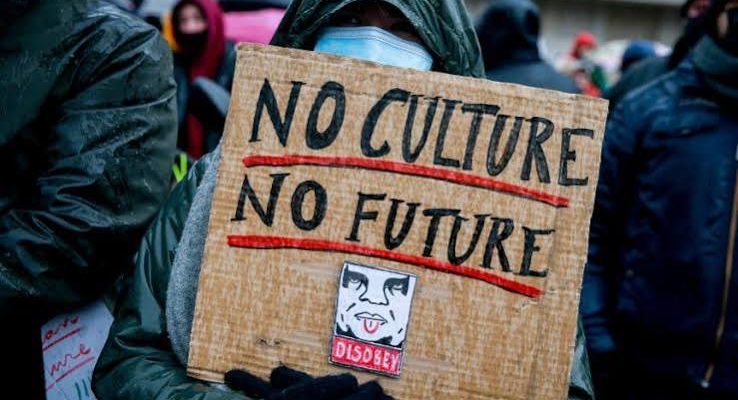
The challenges surrounding the funding and long-term sustainability of cultural activities are now part of a broader context of political and social demands in Belgium, in particular against the Arizona government’s measures; issues of purchasing power, working conditions and public policy also resonate with the realities faced by cultural workers.
The resources allocated to the cultural sector and the conditions necessary to enable artists and the organisations that support them to develop their activities over the long term therefore go beyond the specific circumstances of Get Down. They form part of the social and political demands that are voiced in the streets in Brussels lately. Get Down’s business model thus enables these issues to be addressed in practical terms: how can we remain accessible to artists whilst ensuring the viability of an organisation that supports them?
Between accessibility and economic viability
At Get Down, the majority of the services on offer are free or low-cost. The agency supports artists from the worlds of street and club dance – styles that have historically received less institutional support. If their presence in programming and grant schemes has grown in recent years, the gaps compared with other cultural sectors remain significant.
Added to this is a choice that lies at the very heart of Get Down: supporting emerging artists without charging them an annual fee. This model allows us to remain accessible, but also limits the agency’s own revenue potential. As a result, the agency faces specific challenges arising from the interplay between its philosophy of accessibility, the profile of the artists it supports, and the sector’s overall economic reality.
What is the conclusion to be drawn from this situation? Public funding is essential to the long-term sustainability of our activities. While other sources of funding are obviously being considered to diversify our income, public money remains a fundamental resource for ensuring the viability of our organisation. For Camille, this calls for strategic thinking, even though demand for support remains very high and the projects are numerous and interesting. She explains:
“We need to think about profitability: perhaps supporting fewer artists, but ones who tour a bit more, rather than supporting lots of artists who don’t tour much.”
Having supported nine artists last season, Get Down is now supporting eight. The aim is therefore not to increase the number of projects, but to be able to offer higher-quality support, with more time devoted to each artist and, ultimately, more tour dates.
Funding the organisation’s activities
Today, public funding remains essential to Get Down’s continued operation. In particular, the organisation benefits from a service contract with the Fédération Wallonie Bruxelles, which is due to expire in 2026. An application for renewal was submitted on 1 March, requesting a higher level of funding than the current amount in order to strengthen the team and expand activities. A response is expected in November.
“With the amount currently allocated, it’s a bit like a snake biting its own tail.”
Admittedly, the current funding keeps the organisation running, but it is not yet sufficient to cover all the posts needed for its development: Camille works full-time on a four-fifths contract and Marta works part-time. The aim would be, in particular, to consolidate these roles and strengthen communication and outreach with another part-time contract. Get Down is also awaiting a response regarding an application submitted to the COCOF for the Brussels-Capital Region. These decisions will be crucial in enabling the agency to draw up a provisional budget for the coming years.
At the same time, Get Down is seeking to develop other sources of income. One-off paid support services already exist, but these are deliberately kept to a minimum in order to ensure that sufficient time can be devoted to the artists the agency supports over the long term. The agency also plans to incorporate more distribution and production costs into the budgets of the creative projects it supports. However, for Camille, it remains very important not to undermine artistic projects: if a project’s budget is reduced, Get Down readjusts its own model rather than asking the artist to make up the shortfall.
“We’ll rethink the budgets together and we’ll always take the approach that allows the artist to realise their work. It’s a balance between upholding our values, supporting artists and, at the same time, remaining viable and profitable.”
Diversification also involves exploring new avenues of funding. In early October, Camille undertook a training course with Prométhéa on corporate sponsorship. The aim is to explore other sources of funding and collaborations with businesses, whilst ensuring that partners remain aligned with Get Down’s values.
The vision for the future: still the same, but stronger
“In the current climate, this should enable us to carry out the mission for which Get Down was created: to help raise the profile of artists’ projects, their realities, their representation and their stories, and to forge further collaborations with venues. To carry on doing what we do, but better, with high standards, whilst always staying true to our original intentions. That won’t change.”
Regardless of the amount of funding secured, the challenge for the coming years is not to fundamentally transform the Get Down project, but to structure it more effectively, to consolidate it and to ensure its long-term sustainability. This involves, in particular, a clearer vision of the agency’s values, the artists it supports, and the reasons for and duration of its support. The aim is also to strengthen governance, notably by incorporating key figures into an advisory committee reporting to the general meeting. Drop-in sessions will also remain part of the programme, with a view to further developing the workshops.
For Get Down, the challenge over the coming years is therefore to consolidate what already exists, whilst developing new tools and new ways of communicating. Always with the same priority:
“I really want to respond as effectively as possible to their aspirations and objectives in their artistic journey and creative projects. I really want the creations to tour, to be seen, and for the artists to reach out with audiences. That’s what allows us to sow the seeds. And not just in Belgium, but on an international level as well.”
* This article is based on an interview with Camille Philippot, founder and general coordinator of Get Down, conducted by Jeanne Carella on 24 October 2026.